
How Professional Stylists Actually Choose the Right Hair Colour (Most Women Never Get Told This)
Most women pick hair color from Instagram. Professional stylists don’t. Here’s the real framework luxury hair specialists in Dubai use — and why getting this right changes everything.
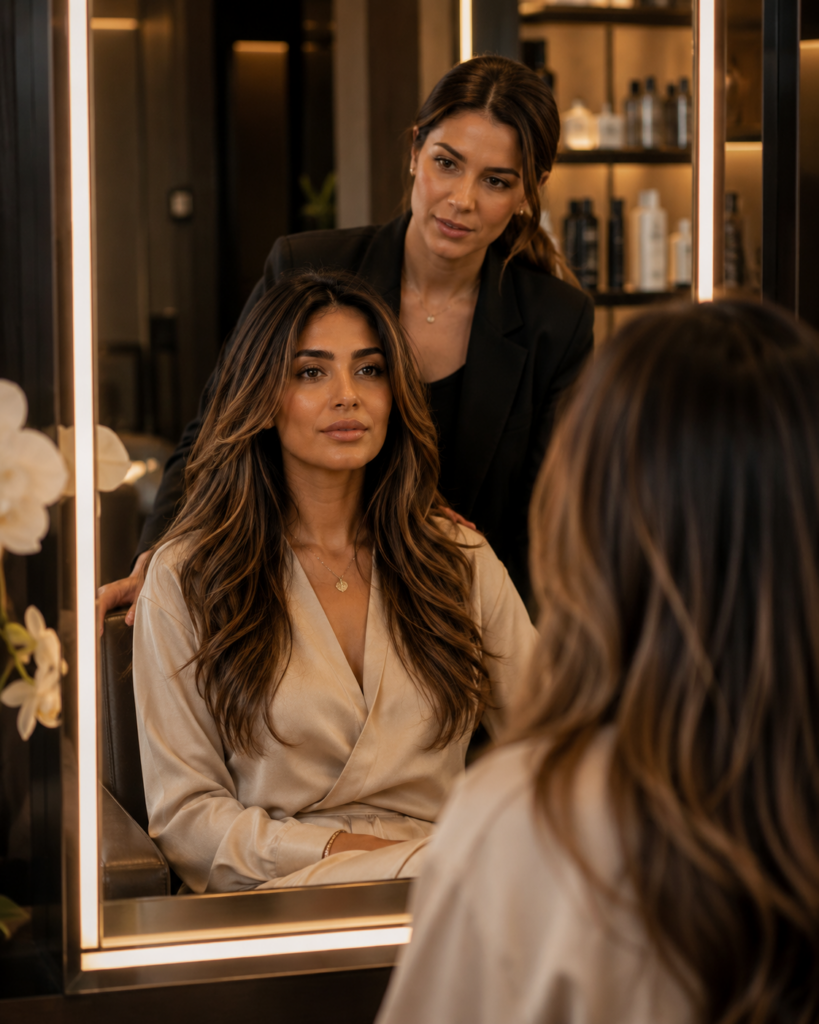
The Color You Want Isn’t Always the Color That’s Right for You
There’s a moment that happens in almost every hair color consultation.
A woman sits down. She pulls out her phone. She shows a photo — usually someone on Instagram, sometimes a celebrity — and says, “I want this.”
The photo is beautiful. The color is beautiful.
But here’s what no one tells her: that color was chosen for that woman. Her skin tone. Her natural depth. Her hair’s current condition. Her lifestyle.
It wasn’t chosen for you.
That’s not a problem with your taste. Your taste is probably excellent. The problem is that choosing hair color from a photo is like choosing shoes by pointing at someone’s feet on the street. It might work. But it might not. And you won’t know until it’s done.
Professional stylists know this. It’s why the best ones spend more time asking questions than mixing colors.
This article walks you through the real framework — the one DHA-certified specialists at luxury salons use when they’re getting a color right from the very first appointment.
By the time you finish reading, you’ll understand why the color you leave with is almost never the one you walked in wanting. And you’ll understand why that’s actually a very good thing.
Why Getting Hair Color Right Is Harder Than It Looks
Hair colour looks like an aesthetic decision. It isn’t.
It’s a technical one with an aesthetic outcome.
The color that makes one woman look radiant will make another look tired. The same shade on different skin tones reads completely differently. The same technique on damaged hair vs. healthy hair produces completely different results.
And yet most women walk into salons — even expensive ones — having already decided what they want. They’ve done the research. They’ve saved the references. They feel ready.
The problem isn’t the research. The problem is that Instagram doesn’t know your skin undertone. It doesn’t know your hair’s porosity. It doesn’t know how much maintenance you’re willing to do in Dubai’s heat. It doesn’t know what you looked like before, or what emotional experience you’re hoping this color will create.
A professional stylist knows how to find all of that out. And then use it.
Here’s how they do it.
The Real Framework: How Professionals Choose the Right Hair Color
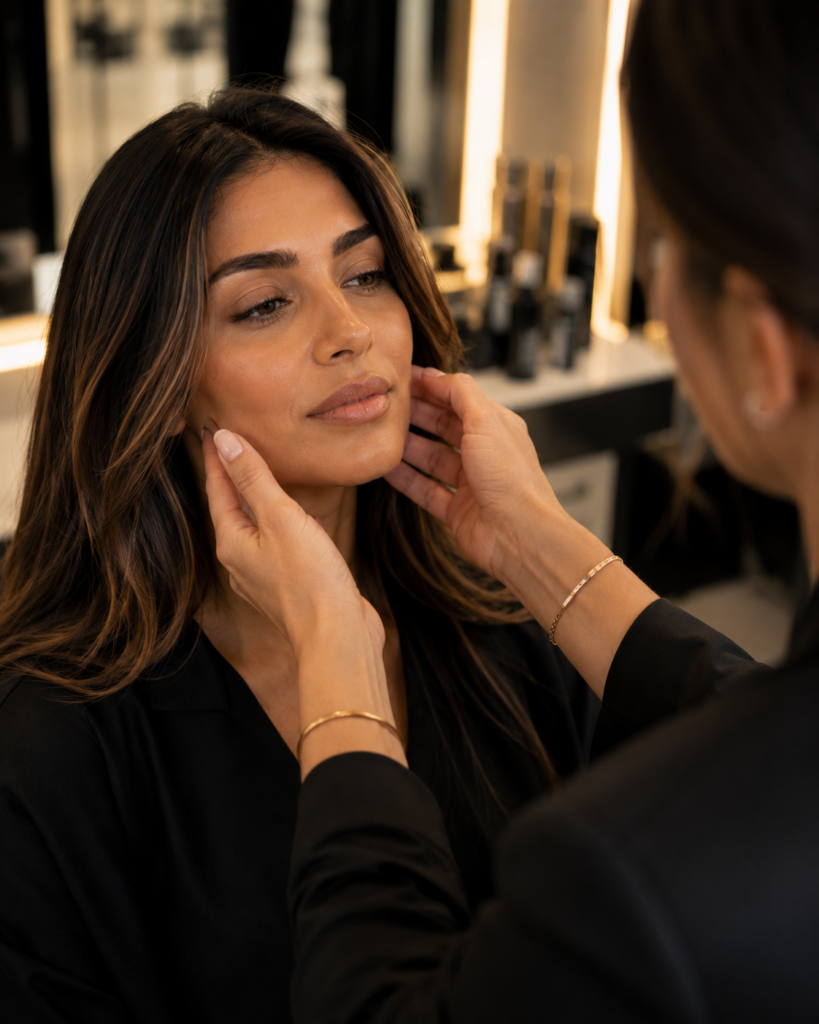
1. They Start With Your Skin — Not Your Hair
Before a professional stylist thinks about color, they look at your face.
Specifically, they look at your skin’s undertone. This is the warm, cool, or neutral quality sitting beneath the surface of your complexion. It doesn’t change with a tan. It doesn’t shift with the seasons. It’s just there — and it’s the single biggest factor in whether a hair color makes you look alive or washed out.
Warm undertones (golden, peachy, yellow) harmonize with warm hair colors. Think copper, golden blonde, chocolate brown, caramel balayage.
Cool undertones (pink, red, bluish) sit better with ash, cool brunette, platinum, or icy tones.
Neutral undertones get the most flexibility — they can carry both warm and cool shades depending on contrast and depth.
Most women don’t know their undertone. Most stylists who skip this step produce color that technically looks good in photos but feels slightly wrong in person — the kind of color you can’t quite put your finger on why it doesn’t suit you.
This is where the conversation matters as much as the technique.
Related: Luxury Hair Transformation Guide — The 2026 Expert Edition
2. They Assess Your Natural Depth and Base
Your natural hair color — or your current color if you’ve been coloring for a while — isn’t just context. It’s the canvas.
Professional stylists use a depth scale from 1 (black) to 10 (lightest blonde) to identify exactly where you’re starting. This matters because lifting color, depositing color, and toning all behave differently depending on the base.
A woman with a level 4 natural base who wants level 8 blonde isn’t getting there in one appointment safely. A woman with heavily highlighted hair who wants to go dark needs a color fill before deposit, or the result will be flat and lifeless.
Most color disasters — the ones that end up in color correction chairs — happen because someone skipped this assessment. Or rushed it.
The right stylist won’t skip it. They’ll tell you honestly what your hair can do today, what it can do in three months, and what the journey looks like in between.
3. They Factor In Your Hair’s Condition
Color doesn’t behave the same on healthy hair as it does on compromised hair.
Porous hair — hair that’s been over-processed, heat-damaged, or chemically treated — absorbs color faster and releases it faster. This means color can go too dark, too fast, and fade unevenly.
Resistant hair — thick, coarse, virgin hair — needs more processing time and lift to take color evenly.
Before a single drop of color is mixed, a professional will feel your hair. They’ll check for elasticity (how well it stretches and returns without breaking). They’ll assess porosity. They’ll ask about your history — what’s been done to your hair, when, and with what.
This is why luxury salons often recommend a treatment round before a major color change. It’s not upselling. It’s protecting the outcome they’re about to create.
Related: Luxury Hair Treatments That Actually Improve Hair Health
4. They Ask About Your Life — Not Just Your Look
This is the one that separates the professionals from the technicians.
What does your week look like? Do you wash your hair every day or twice a week? How much time do you spend in direct sun? Are you in the sea or the pool regularly? Do you use heat tools every morning?
All of this changes what color will work for you long-term.
A woman who travels constantly for work and can’t keep monthly root appointments needs a color that grows out softly — a balayage, a shadow root, a technique with built-in dimension. A woman who washes daily in Dubai’s hard water needs color and a toning strategy that accounts for faster fade. A woman who swims three times a week needs to know what chlorine does to blonde tones — and what to do about it.
Color that suits your life is color that keeps looking good for weeks after you leave the salon. Color that ignores your life starts to look wrong the moment real daily routine kicks in.
Related: How to Maintain Salon Hair in Dubai’s Heat and Humidity
5. They Know Which Techniques Deliver Which Results
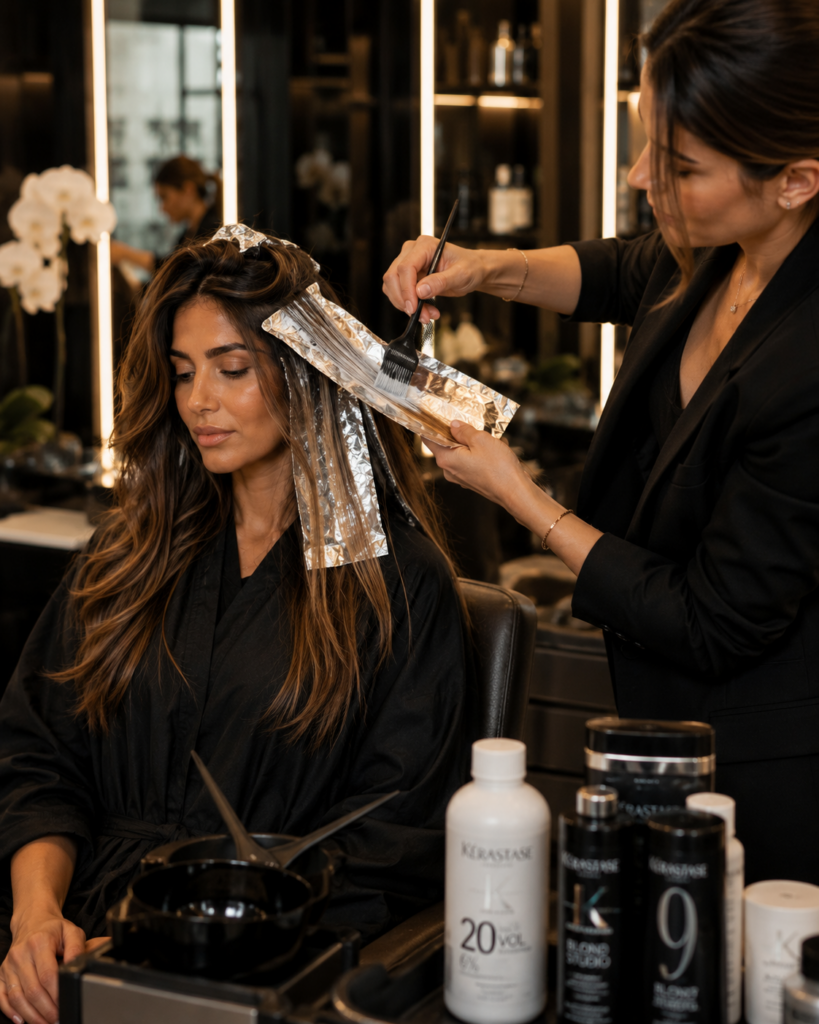
There isn’t one way to color hair. There are dozens. And each one does something different.
Here are the most commonly requested color techniques — and what they actually do:
Balayage Hand-painted highlights with no foils. Creates natural, sun-kissed dimension that grows out softly. Low maintenance. Best for natural, lived-in looks. Works across most skin tones when the tones are chosen correctly.
Highlights and Foils More uniform, more structured brightness than balayage. Better for dramatic lift or precise color placement. Higher maintenance because the regrowth line is more defined.
All-Over Color Single shade applied root to tip. Used for full coverage, dramatic changes, going darker, or correcting uneven color. Requires more frequent maintenance.
Babylights Very fine, delicate highlights placed close together. Mimics the natural color variation of childhood hair — light, dimensional, almost translucent. Creates the most natural-looking blonde result.
Toning Not a color technique in itself, but the final step that defines the shade. This is where ash, gold, copper, and beige tones come from. Most color disasters are actually toning errors — the lift was correct, but the tone was wrong.
Color Correction A multi-step process to fix color that went wrong — too brassy, too dark, uneven, or damaged. This isn’t a single appointment. It’s a color rehabilitation programme.
Colour Melting Seamless blending of two or three tones from root to tip. Creates a gradient effect with no harsh lines. Looks expensive. Works beautifully for dimensional brunettes and warm blondes.
Related: Signs You Need a Hair Color Correction Specialist
6. They Choose Products That Match the Ambition
The color formula matters. The developer strength matters. But the products used — the quality of the pigments, the conditioning agents in the formula, the treatment system applied after — these determine how your hair feels when it’s done.
A technically correct color applied with poor-quality products will leave hair that looks great in the salon and falls flat three washes later.
At Elaris, the product choice is part of the service design, not an afterthought. Professional-grade formulations — including Wella color systems and luxury brands like Dior, Chanel, Givenchy, and Yves Saint Laurent in the care and finish stages — are selected to support not just the color result, but the health of the hair underneath.
Please note: product use varies by service. Speak to your specialist at consultation to confirm which products will be used for your treatment.
Related: A Real Guide to Luxury Hair Transformations in Dubai 2026
7. They Think About Maintenance Before the First Foil Goes In
A good stylist doesn’t just think about what your hair will look like when you leave. They think about what it will look like in four, six, and ten weeks.
Low-maintenance color is designed into the application. It’s not something you achieve by styling around regrowth — it’s built in from the first stroke.
High-contrast results (dramatic blonde, strong copper, deep red) are beautiful. They’re also high-commitment. A professional will tell you this before you commit, not after the color is in.
This conversation — about what you’re willing to do, how often you can come back, what your hair can handle — is what separates a color that keeps looking good from a color that looks great once.

Who Needs This Kind of Approach
Not everyone who colors their hair needs a full technical assessment. But some women really do — and they often don’t realize it until they’ve had one result too many that looked right on screen and wrong in the mirror.
You’ll benefit most from a proper professional color consultation if:
- You’ve been coloring at home and want to transition to professional color
- You’ve had a color result you didn’t love and couldn’t explain why
- You’re making a significant change — going lighter, darker, or dramatically different
- You’ve been using box dye and want to go blonde (this is the most common color correction scenario)
- Your hair is fine, damaged, or has been chemically treated
- You’re in Dubai and dealing with sun exposure, humidity, and hard water daily
- You’ve never had anyone explain your undertone or depth to you properly
You don’t need to arrive with a clear picture of what you want. You just need to arrive. The consultation is where it gets figured out.
What Gets It Right vs. What Goes Wrong
What produces a great result:
- A genuine consultation before color is mixed
- An honest assessment of your hair’s current condition
- A specialist who listens more than they talk in the first ten minutes
- Realistic expectations set before the appointment, not after
- Quality product chosen for your specific hair type and color goal
- A toning step that’s treated as seriously as the lifting step
What creates color problems:
- Skipping the consultation and going straight to application
- Choosing color from a photo without discussing skin tone
- Rushing a result that needs multiple sessions to achieve safely
- Using a developer strength that’s too high for compromised hair
- No aftercare plan given at the end of the appointment
- Hard water and Dubai’s sun left out of the maintenance conversation entirely
If you’ve experienced the second list more than once, it’s not your hair’s fault. It’s not your taste’s fault. You were just in the wrong room.
What Clients Say After Getting It Right
Bertena M came into the salon wanting her hair done. She left with something more than that.
“I love my hair, lovely staff very kind. Special word for Aber, who has helped me fantastic. This talented man who needs very few words and does his very best to please the client. I have appreciated that. Definitely I will come when I visit Dubai again.”
That phrase — “does his very best to please the client” — sounds simple. What it actually describes is a specialist who read the person in front of him, not just the request. Aber didn’t need many words because he was already paying close attention.
Mahima experienced the same thing from a different angle:
“I went yesterday for a new and fresh look, and it was an amazing experience. They were very professional and friendly. I really loved my haircut — it gave me such a classy look. Highly recommended!”
A classy look doesn’t happen by accident. It happens when someone who knows what they’re doing takes what you have and makes it more itself.
And Anamika, who simply wanted exactly what she asked for:
“Amazing experience with Adel. I got the haircut exactly the way I wanted. I will definitely be a returning client, especially for Adel. The overall service and hospitality were outstanding.”
Exactly the way I wanted. That’s the standard. Not an approximation. Not a version of. Exactly.
Daily Care Tips After Color (Dubai-Specific)
Color doesn’t end at the salon. What happens in the next 72 hours — and the weeks after — determines how long your result looks the way it did when you left.
Week one:
- Avoid washing for 48-72 hours after coloring. The cuticle needs time to close and lock in the pigment.
- Use cool or lukewarm water when you do wash. Hot water opens the cuticle and accelerates fade.
- Avoid direct sun on freshly coloured hair. Dubai’s UV intensity is significant year-round.
Ongoing:
- Use a sulphate-free, color-safe shampoo. Sulphates strip color faster than anything else.
- Apply a leave-in UV protectant if you’re outdoors regularly. Sun is the most consistent enemy of color longevity in Dubai.
- Use a weekly color-deposit mask if you’re a blonde or red tone. These replace the pigment that washes out between appointments.
- Install a shower filter if you can. Dubai’s tap water is high in minerals that deposit on hair and dull color over time.
For the salon: Book a toning refresh between color appointments if you’re maintaining a light blonde. Toning fades faster than lift. A 30-minute toning appointment keeps your color looking fresh without a full recolor.
Related: The Psychology of Luxury Beauty Experiences

Frequently Asked Questions
Q: How do I find out my skin undertone before a consultation?
A: Look at the veins on your inner wrist. Blue or purple veins suggest cool undertones. Green veins suggest warm undertones. A mix of both suggests neutral. You can also check how your skin reacts to gold vs. silver jewelry — gold flatters warm undertones, silver flatters cool. Your stylist will assess this properly at consultation, but these are useful starting points.
Q: Can I go from dark hair to blonde in one appointment?
A: In most cases, no — not safely. Lifting dark hair to light blonde requires significant processing. Trying to rush this in a single session typically results in damage, uneven results, or an orange tone that needs correction. The right stylist will plan this as a multi-stage process and give you a realistic timeline from the start.
Q: How often should I come in to maintain my hair color in Dubai?
A: It depends on the technique. Balayage and color melt can go 10-16 weeks between appointments. All-over color typically needs refreshing every 4-8 weeks depending on how fast your hair grows and how much contrast is visible at the root. Toning appointments can be booked every 6-8 weeks independently to keep blonde tones fresh.
Q: Why does my hair color fade so fast in Dubai?
A: Several factors compound in Dubai specifically. High UV exposure bleaches color, particularly reds and blondes. Hard tap water deposits minerals that dull and alter tone. Frequent washing due to humidity and heat increases fade rate. Air conditioning also dries hair, which opens the cuticle and allows color to escape faster. A proper aftercare routine, UV protection, and a shower filter make a material difference.
Q: What is color correction and when do I need it?
A: Color correction is the professional process of fixing color that went wrong — whether that’s brassiness, uneven lift, color that’s too dark, or damage from incorrect processing. Signs you need it include patchy color, orange or green tones in blonde hair, color that looks completely different in different lights, or hair that’s snapping or excessively dry. This article explains the signs in detail.
Q: How do I know if a salon is qualified to do my color?
A: Ask about certifications. In Dubai, DHA (Dubai Health Authority) certification is the professional standard for hair and beauty practitioners. Ask about the color systems they use — professional-grade brands like Wella behave differently to retail products and require trained application. And pay attention to the consultation. A salon that skips the consultation and goes straight to mixing is telling you something important about their process.
The Right color Is Out There. You Just Need the Right Room.
Here’s the thing about hair color.
It’s not about finding the most beautiful shade in the world. It’s about finding the right shade for you — the one that makes your skin glow, your eyes stand out, and your whole face feel like it came into focus.
That’s not something you find on Instagram. It’s something you find in a conversation with someone who knows how to look at you properly.
Elaris has been that room for women across Dubai since opening the flagship in Business Bay. The team — DHA-certified specialists, Wella-accredited colorists, master-level professionals — has built a reputation not on dramatic transformations, but on results that feel exactly right. That’s why 300+ Google reviews sit at 4.8 stars. That’s why 200+ Fresha reviews say the same. That’s why women fly back to Dubai specifically to come back.
Four locations now. Business Bay. Jumeirah 1. Jumeirah 3. The Village Mall.
If you’ve been settling for color that’s almost right, or you’re ready to finally understand what your hair can actually do — this is the consultation worth booking.