
The Real Difference Between a Luxury Facial and a Regular One — And What Your Skin Actually Needs
Most facials feel good for two days and then disappear. Here’s what separates a facial that actually changes your skin from one that just cleans it — and what women in Dubai need to know before booking.
Most Women Have Never Had a Facial That Actually Changed Their Skin
They’ve had facials that felt good.
That left them glowing in the mirror on the way out. That smelled incredible and came with a shoulder massage and warm towels.
But two days later — nothing. Skin back to exactly where it was. Maybe a little cleaner. Mostly unchanged.
That’s not a facial problem. That’s a category problem. There are two entirely different things that get called a facial. One is a pampering experience. The other is a skin treatment. They feel similar while they’re happening. They produce completely different results over time.
Most women in Dubai have been getting the first kind.
This article explains the difference — what actually happens to your skin during a real treatment facial, why Dubai’s climate makes professional skin care more important than almost anywhere else, and how to know which type of facial your skin actually needs right now.
What’s Actually Happening to Your Skin in Dubai
Before talking about facials specifically — here’s what your skin is dealing with every day in this city.
Dubai’s tap water is hard. It measures between 120 and 200 mg/L of dissolved minerals — calcium and magnesium — which puts it in the “hard” to “very hard” range. Every time you wash your face, those minerals deposit on your skin. Over time they disrupt the skin’s protective barrier, clog pores, and accelerate dryness. Research published in the Journal of Investigative Dermatology found that hard water exposure significantly worsens skin sensitivity and eczema — and many Dubai expats report clear skin at home and breakouts or dryness within weeks of arrival.
Then there’s the UV. Dubai’s sun is intense year-round — not just in summer. UV exposure is the primary driver of premature skin aging: pigmentation, fine lines, loss of collagen. Wearing SPF helps. It doesn’t eliminate the cumulative effect of daily exposure.
And then the climate cycle. Air conditioning dries the skin continuously from the inside of every building. The outdoor heat and humidity swell and stress the skin barrier from the outside. Moving between the two repeatedly throughout a Dubai day puts the skin under a level of environmental stress most of us underestimate.
The result: skin that looks tired faster, dehydrates more quickly, accumulates mineral buildup, and needs more structural support than it would in a softer climate.
A facial that just cleans the surface addresses almost none of this. A facial designed around what your skin actually needs here — that’s a different service entirely.
What a Regular Facial Does
A regular facial — the kind you find at most salons and spas — follows a standard protocol.
Cleanse. Steam. Exfoliate. Extract. Mask. Moisturize.
It feels wonderful. The steam opens the pores. The exfoliation removes surface dead skin cells. Extractions clear congestion. The mask hydrates or soothes. You leave looking cleaner and brighter.
What it doesn’t do: reach below the surface. Address the skin’s structural layers. Stimulate collagen or elastin production. Correct pigmentation. Repair a compromised barrier. Target anything at a cellular level.
It’s maintenance. Useful, pleasant, and real — but limited to the surface.
The glow fades because nothing structural changed. The skin cleaned up what it accumulated. Then it accumulated again.
What a Luxury Facial Actually Does
A luxury facial at a properly equipped salon starts differently.
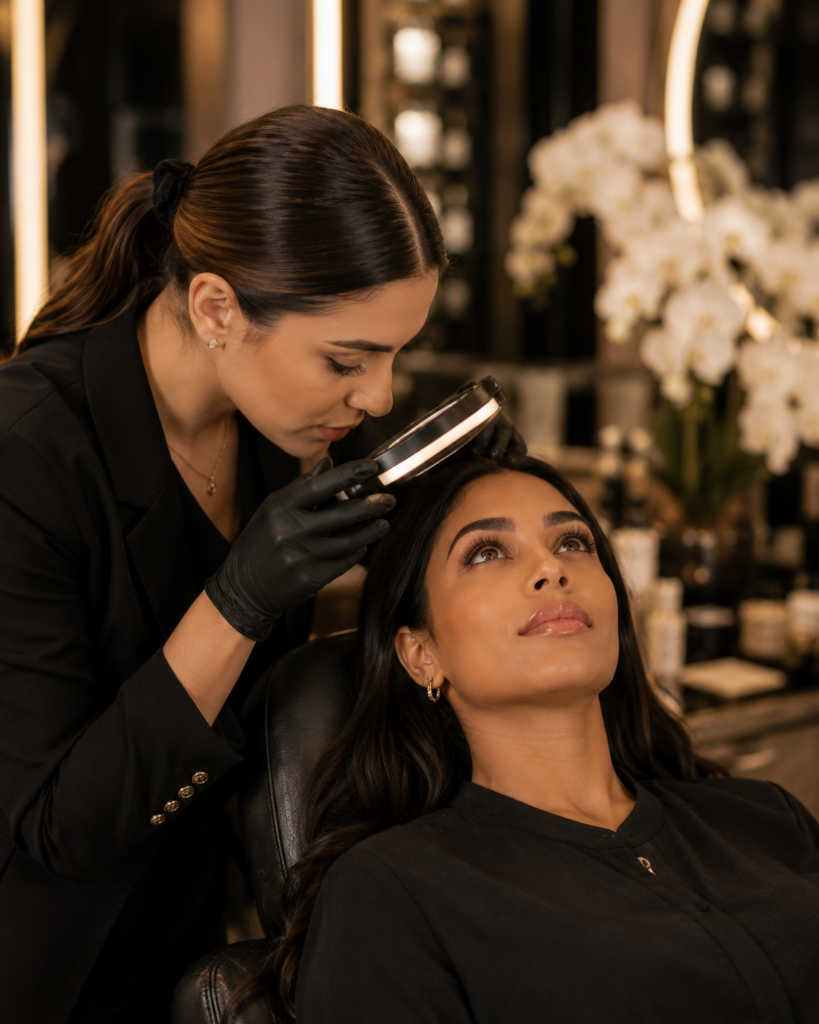
Before any product touches your skin — a skin analysis happens.
Not a visual once-over. An actual assessment of your skin type, your current hydration level, your sensitivity, your specific concerns, and the history of what’s been happening to your skin. In Dubai, this includes asking about your water, your sun exposure, your skincare routine at home, and any reactions you’ve had to products or treatments.
That assessment determines everything that follows — the products used, the techniques applied, the treatment depth, the active ingredients chosen.
Then the treatment begins. And depending on what your skin needs, it might include:
Deep Hydration Treatments
Dubai’s climate creates chronic transepidermal water loss — moisture escaping from the skin continuously. A surface moisturizer replaces some of it. A professional hydration treatment works at a deeper level — infusing hyaluronic acid and humectants below the surface barrier to restore what the environment removes daily.
A 2025 peer-reviewed clinical trial published in the Journal of Cosmetic Dermatology evaluated a multi-component facial treatment over 28 days. The study found measurable improvements in skin hydration, barrier repair, and elasticity — with results building across the treatment period rather than peaking on day one. This is the difference between a surface treatment and a structural one.
Chemical Exfoliation
Physical scrubs remove dead surface cells mechanically. Chemical exfoliation — using AHAs like glycolic acid or BHAs like salicylic acid — dissolves the bonds between dead cells and resurfaces the skin more evenly and more deeply.
For Dubai skin specifically, controlled chemical exfoliation addresses the pigmentation and uneven texture that accumulates from UV exposure. It also accelerates cell turnover — the process that slows down naturally from our mid-twenties and contributes to dull, thickened skin tone over time.
Professional-grade chemical exfoliation is calibrated to your skin type and sensitivity. The concentration, the contact time, the neutralization — all managed by a trained specialist rather than a fixed-time product applied uniformly.
Collagen Stimulation
Collagen is the structural protein that keeps skin firm and elastic. From the mid-twenties, production slows at roughly 1% per year. UV exposure accelerates the breakdown further.
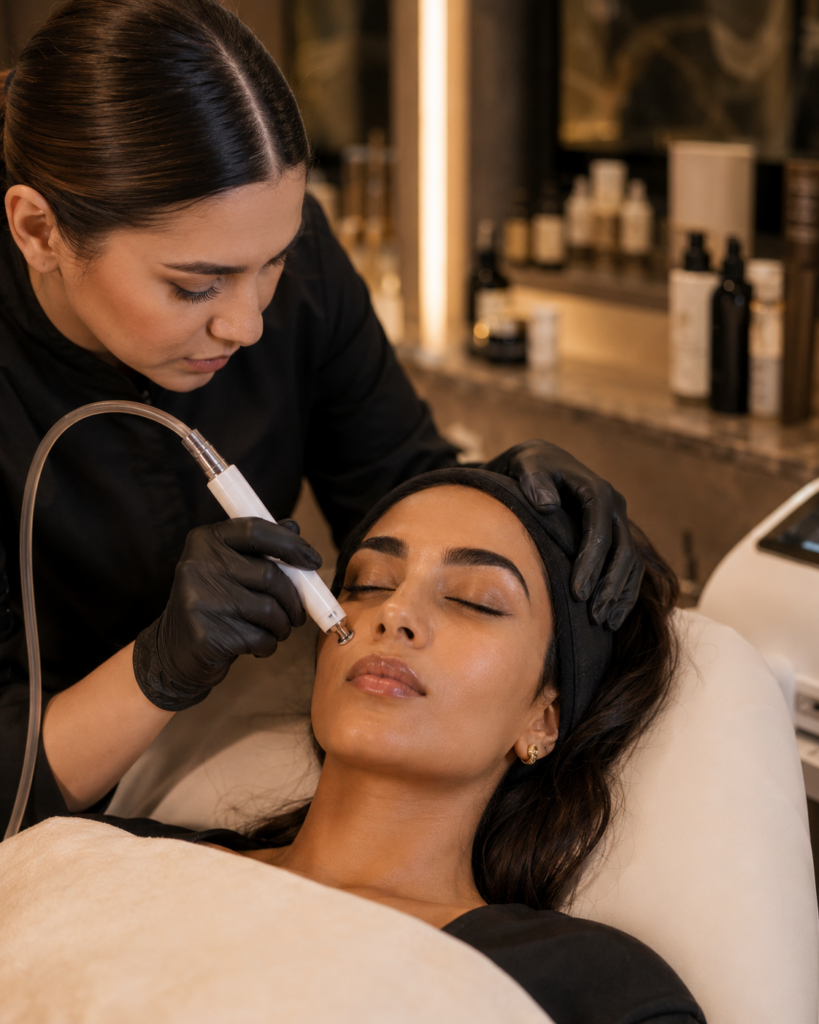
Professional treatments that stimulate collagen — LED light therapy, microcurrent, specific active ingredient combinations — work at the dermal layer rather than the epidermis. The effect isn’t immediate visible glow. It’s gradual structural improvement. Skin that holds its shape better over time. Lines that develop more slowly. Firmness that responds rather than just looks good on one day.
Barrier Repair
The skin barrier is the outermost layer — a protective shield of lipids and proteins that keeps moisture in and environmental stressors out. Dubai’s combination of hard water, UV, air conditioning, and sometimes over-exfoliation at home compromises this barrier in most women here.
A compromised barrier means skin that reacts more, dehydrates faster, and struggles to respond to the active ingredients in your home skincare. Professional barrier repair treatments — using ceramide-rich formulations, niacinamide, and gentle but targeted actives — rebuild this layer so that everything you do at home actually works the way it should.
Targeted Treatments for Specific Concerns
Anti-aging. Pigmentation correction. Acne and congestion. Sensitivity and redness. Each of these requires a different approach — different active ingredients, different treatment depth, different protocols.
A luxury facial doesn’t take one approach and apply it to every client. It takes the assessment at the beginning seriously and builds a treatment around the specific concern rather than the most popular service on the menu.
The Dubai Skin Calendar: Why Timing Matters Here
Unlike most cities, Dubai’s skin care needs shift significantly across the year.
October — March (cooler months): The skin is under less UV and heat stress. This is the ideal window for more active treatments — chemical peels, brightening protocols, collagen stimulation. The skin recovers more easily and responds more strongly.
April — September (hotter months): UV is at its most intense. Active treatments that increase photosensitivity — strong peels, certain laser-adjacent treatments — need careful timing and mandatory SPF management. Hydration and barrier protection become the priority. This is when regular professional hydration facials pay off most visibly.
A specialist who understands Dubai’s calendar doesn’t just ask what your skin needs. They ask what your skin needs right now, in this month, in this climate.
Who Needs a Professional Facial — and How Often
Every woman living in Dubai. The climate here creates skin stress that home skincare partially but not fully addresses. Professional treatment bridges the gap between what products can do and what the skin actually needs.
More specifically:
If your skin looks dull or tired: Chronic dehydration from hard water and air conditioning. A professional hydration treatment resets the baseline. Monthly is ideal.
If you’re noticing early pigmentation: Sun-related pigmentation accumulates gradually and is far easier to address early than after it’s settled. A brightening facial protocol every 4-6 weeks during cooler months makes a significant difference.
If your skin reacts to everything: A compromised barrier. Barrier repair treatments followed by a simplified home routine usually resolves this within a few appointments.
If your skin looks the same regardless of what you do at home: The products aren’t penetrating — likely because of mineral buildup from hard water or a barrier that needs professional attention first.
If you’ve never had a proper skin analysis: Start there. Everything else follows from knowing what your skin is actually doing rather than guessing.
What a Luxury Facial Should Feel Like From the Start
The experience of a genuinely luxury facial begins before the treatment.
The specialist sits with you. They look at your skin. They ask about your daily routine, your water, your sun exposure, your history with treatments, what’s been bothering you. They’re building a picture before they make a single decision.
That conversation tells you everything you need to know about whether you’re in the right room.
A specialist who goes straight to cleansing without that conversation is running a protocol. A specialist who takes ten minutes to understand your skin first is designing a treatment.
The products chosen should be explained — what they are, what they do to your skin, why they were chosen for you specifically. In Dubai, this increasingly means formulations that are natural and vegan where quality allows — the growing demand for clean beauty in the region is not incidental. It reflects a well-founded preference for skin care that supports the barrier rather than stressing it further.
Jasmin N described what a properly designed appointment feels like from the first moment:
“I had the best experience here. Their WA response is so fast, the salon is beautiful, they have a drink menu — you feel so pampered — and Hayma is so amazing at her craft. She’s such a sweet girl as well, and I love my nails.”
The environment, the welcome, the specialist — all of it together is the experience. Not as decoration around the service. As part of the service.
Sreethi noticed the same quality from a different angle:
“They pamper you with drinks of your choice and chocolates too. What else does a girl need?”
What she’s describing isn’t just comfort. It’s the environment in which a proper treatment becomes possible. When you’re genuinely relaxed, your skin responds differently. The nervous system quiets. The muscles release. A treatment applied to tense, guarded skin is a different experience from the same treatment applied when you feel completely at ease.
That difference is part of what makes a luxury facial feel like it changed something — because it did.
The Professional Standard in Dubai
Skin treatments in Dubai are regulated by the Dubai Health Authority. Practitioners performing skin treatments in DHA-certified facilities are assessed to a verified professional standard — not just trained by their employer. You can verify DHA licensing requirements at dha.gov.ae.
For skin treatments specifically, this matters significantly. The active ingredients used in professional facials — AHAs, BHAs, enzymatic exfoliants, active serums — require trained application. Concentration, contact time, skin preparation, neutralization — these are technical decisions that produce very different outcomes depending on the skill of the person making them.
A properly trained, DHA-certified skin therapist brings clinical knowledge to a facial that changes what it can do for your skin.
After Your Facial: Making It Last
What happens in the 48-72 hours after a professional facial determines how long the result holds.
Immediately after: Your skin is sensitized. Avoid active exfoliants — AHAs, BHAs, retinol — for at least 48 hours. No aggressive scrubbing. Gentle cleanser only.
Sun protection: SPF every day, without exception, is more important after a facial than before. Many treatments increase photosensitivity temporarily. Dubai’s UV makes skipping it genuinely harmful to the result.
Hydration: Keep the skin hydrated — a gentle hyaluronic acid serum and a barrier-supportive moisturizer. Nothing complicated. The skin is in repair mode and needs support, not a full actives routine.
For lasting results: A single facial resets your skin. A consistent facial schedule — monthly for most women in Dubai — builds on each treatment and produces cumulative improvement rather than a single-day glow.
Related: How Often Should You Really Visit a Salon?
Frequently Asked Questions
Q: What is the difference between a regular facial and a luxury facial?
A: A regular facial follows a standard protocol — cleanse, steam, exfoliate, extract, mask, moisturize — and addresses the skin’s surface. A luxury facial begins with a proper skin analysis and builds a treatment around your specific concerns, skin type, and lifestyle. It uses professional-grade active ingredients at appropriate concentrations, may include targeted technologies like LED or microcurrent, and works at the structural level rather than just the surface. The visible result of a luxury facial continues to develop over days — not just hours.
Q: How often should I get a facial in Dubai?
A: Monthly is the most effective frequency for most women in Dubai. The combination of hard water, UV exposure, air conditioning, and the city’s pace creates ongoing skin stress that home skincare partially addresses. A monthly professional facial bridges the gap — addressing mineral buildup, dehydration, and any developing concerns before they become harder to correct. During cooler months (October to March), more active treatments can be scheduled. During hotter months, hydration and barrier protection take priority.
Q: What type of facial is best for Dubai’s climate?
A: It depends on your specific concern. For chronic dehydration — the most common Dubai skin issue — a professional hydration facial using hyaluronic acid and barrier-repair actives is the most effective starting point. For pigmentation from UV exposure, a brightening protocol with controlled chemical exfoliation works best during cooler months. For congestion and clogged pores from hard water and humidity, deep cleansing with professional-grade extractions and targeted treatment is more appropriate. A proper skin analysis at consultation determines which approach is right for you.
Q: Are professional facials better than home skincare?
A: They address different things. Home skincare maintains what a professional facial establishes. Professional facials work at depths and with concentrations that home products can’t reach safely without clinical supervision. The most effective approach combines both — regular professional treatments supported by a well-chosen home routine. In Dubai specifically, professional treatments are more important than in most cities because the environmental stressors are more consistent and more intense.
Q: What should I tell my skin specialist before a facial?
A: Your daily skincare routine at home. Any products you’re currently using — especially actives like retinol, AHAs, or BHAs, because these affect how your skin will respond to treatment. Your history with facials and any reactions you’ve had. How much sun exposure you get. Whether you’ve noticed any changes in your skin since moving to Dubai if you’re an expat. The more context your specialist has, the more accurately they can design a treatment that actually addresses what your skin needs.
Q: Is a facial safe for sensitive skin?
A: Yes — when performed by a trained specialist who assesses your sensitivity before starting. Sensitive skin in Dubai often reflects a compromised barrier rather than inherently reactive skin. A barrier-repair facial — using gentle, fragrance-free, ceramide-rich formulations — can significantly reduce sensitivity over a course of treatments. The key is telling your specialist about your sensitivity at the consultation and ensuring they adjust the treatment accordingly. A specialist who acknowledges your sensitivity and modifies the protocol is the one to trust.
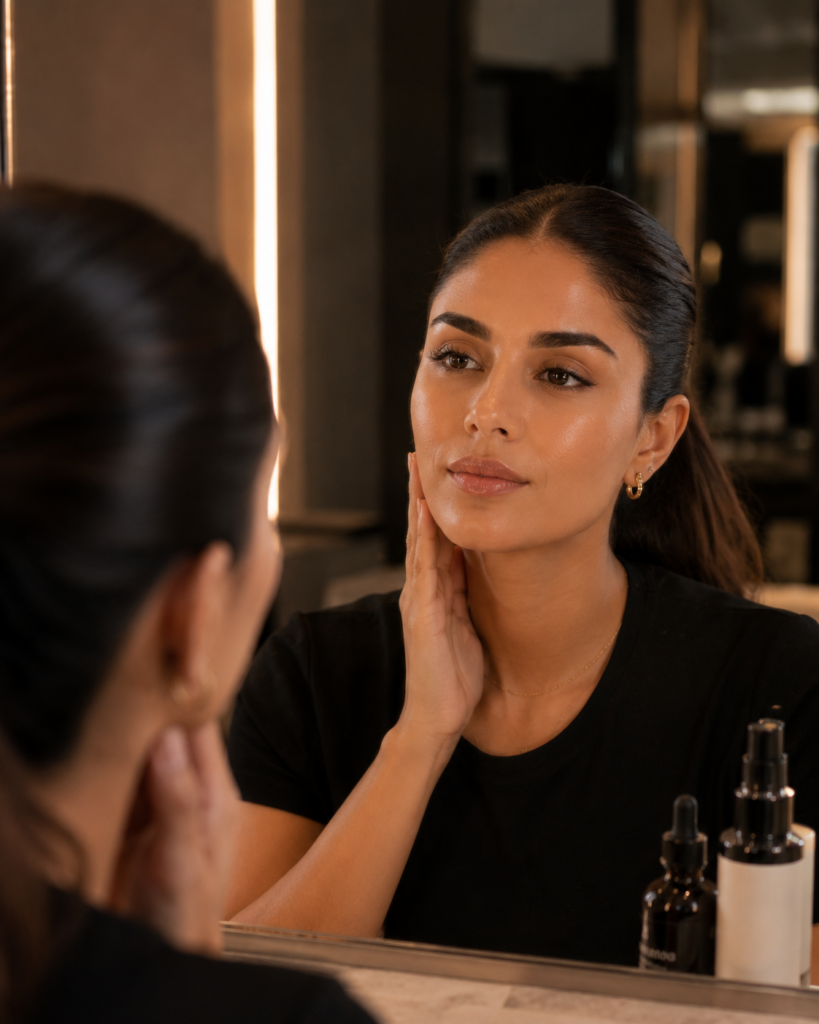
Your Skin Knows the Difference
The glow you walk out with after a well-designed facial isn’t just a surface clean.
It’s your skin functioning the way it’s supposed to — hydrated at the right level, protected, structurally supported. The kind of result that compounds. That looks better at day seven than day one. That changes what your skin does between appointments, not just what it looks like during them.
That result starts with a specialist who takes your skin seriously before they start treating it.
Elaris offers skin and facial treatments across all four Dubai locations — Business Bay, Jumeirah 1, Jumeirah 3, and The Village Mall — by DHA-certified skin specialists who design every treatment around the person in the chair. Natural and vegan formulations where quality allows. Products chosen for what your skin actually needs here — in this climate, in this city.
4.8 stars on Google from over 300 reviews. 4.8 on Fresha from over 200 more. Consistently, because the standard applied to skin treatments is the same standard applied to every service.
If your skin has been feeling like it’s just managing — not quite right, not quite bad, just not responding the way you want — a proper skin consultation is the place to start.